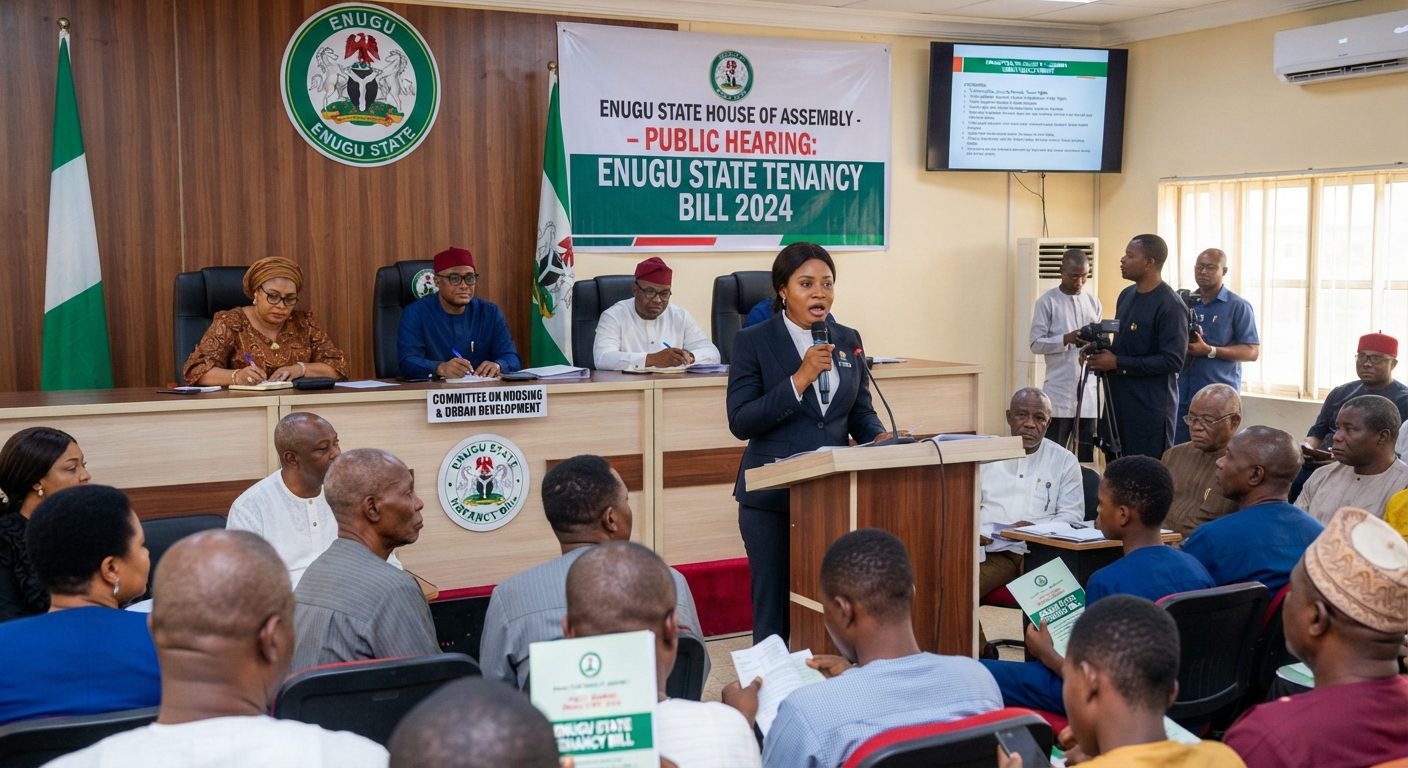
As widely reported across mainstream media, the Enugu State House of Assembly recently took a decisive legislative step by passing the Landlord and Tenant Second Amendment Bill, Cap. 101, Revised Laws of Enugu State 2024 (House Bill No. 3, 2025). Awaiting the assent of Governor Peter Mbah, this landmark legislation prohibits landlords from increasing rent for a minimum of four years, caps subsequent hikes at a strict two per cent, and allows up to a 10 per cent adjustment only when verifiable, substantial renovations are carried out. Sponsored by Hon. Iloabuchi Abugu, seconded by Deputy Speaker Rt. Hon. Jane Eneh, and championed by Speaker Rt. Hon. Uche Ugwu alongside committee chairman Rt. Hon. Okey Mbah, the bill is designed to dismantle arbitrary agency fees, excessive legal charges, and exploitative rent spikes. While some property owners, such as Enugu landlord Mr. Onyekwere Johnson, have pushed back against the cap by pointing to inflation and rising utility costs, the Assembly’s intervention highlights a critical turning point in addressing one of Nigeria’s most pressing socioeconomic emergencies.
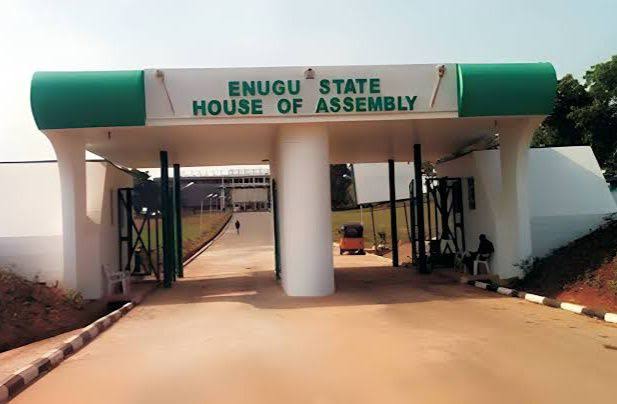
Enugu State House of Assembly complex, Enugu State.
Confronting Nigeria’s Housing Deficit and the Rent Crisis
Nigeria is currently grappling with a staggering housing deficit estimated at tens of millions of units, a crisis that leaves millions of citizens either homeless, living in overcrowded slums, or spending an unsustainable portion of their income on shelter. While rapid urbanization and population growth contribute to this gap, the unchecked escalation of house rent is a primary driver of the crisis. Across major urban centers, landlords and middlemen routinely demand one to two years of rent upfront alongside inflated agency and legal commissions. When rent increases arbitrarily every year without corresponding wage growth, existing housing stock becomes artificially inaccessible to low- and middle-income earners. In Enugu metropolis, residents have long cried out against this predatory cycle, prompting lawmakers to step in and restore fairness to the rental market.
The Economic Toll of Skyrocketing Rent
The relentless surge in housing costs does far more than strain household budgets; it actively suffocates the broader Nigerian economy. When workers, civil servants, and young professionals surrender over half of their annual earnings just to keep a roof over their heads, their disposable income evaporates. Consumer spending, the lifeblood of retail, hospitality, local manufacturing, and small businesses, stalls. Furthermore, high commercial and residential rents drive up the cost of doing business, forcing entrepreneurs to pass those expenses onto consumers through higher prices for goods and services, thereby fueling nationwide inflation. Capital that could otherwise be invested in startups, education, healthcare, or personal savings is instead locked into unproductive real estate rent-seeking.
The Vital Role of Architecture and Material Cost Regulation
Solving the housing and rent crisis requires looking beyond legislation to the physical and economic realities of construction. Architecture holds immense potential to bridge the affordability gap. Nigerian architects and urban planners must champion innovative, climate-responsive designs that utilize modular construction, vertical high-density layouts, and locally sourced, sustainable materials, such as compressed stabilized earth blocks, rather than relying exclusively on expensive imported finishes.
However, architectural ingenuity alone cannot thrive if the foundational inputs of construction remain out of reach. The Nigerian government must urgently intervene to regulate or subsidize the soaring cost of essential building materials like cement, iron rods, roofing sheets, and finishing supplies. Landlords like Mr. Onyekwere Johnson raises a valid concern when they highlight the mismatch between rent caps and inflationary construction costs. By granting tax reliefs to local manufacturers, curbing monopolistic pricing in the cement and steel industries, and offering subsidized building materials for affordable housing developers, the federal and state governments can lower the cost of building, making moderate rents genuinely profitable and sustainable for property owners.
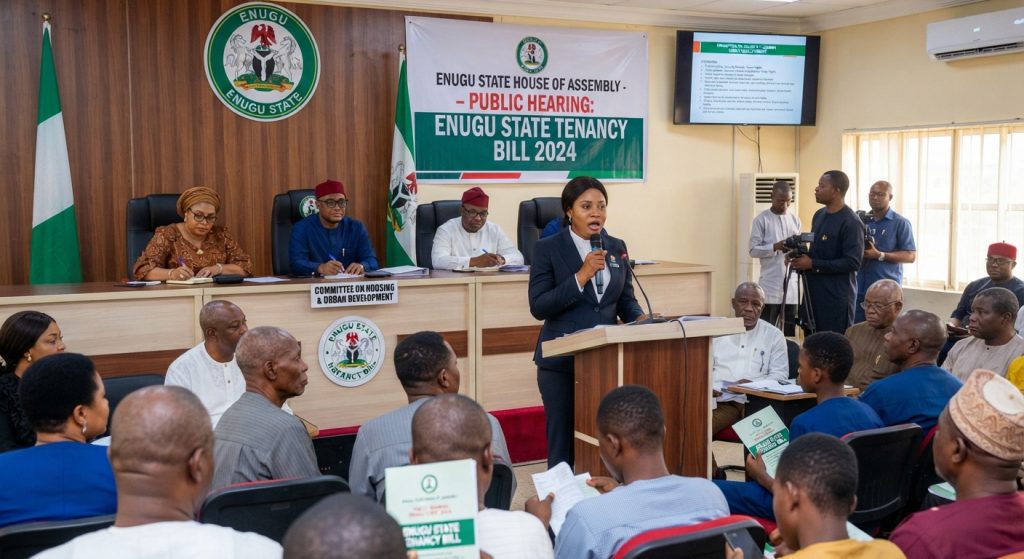
A Gemini AI generated image as an illustration for the article.
Why Landlords, Tenants, and Other States Must Embrace This Blueprint
For Nigeria to unlock sustainable economic growth, the Enugu State House of Assembly’s bold legislative approach cannot remain an isolated regional experiment. State assemblies in Lagos, Rivers, Abuja (FCT), Oyo, Kano, and beyond must adopt and adapt similar Second Amendment tenancy frameworks tailored to their local realities.
More importantly, both landlords and tenants must look past short-term friction and gladly embrace this legal evolution. For tenants, predictable four-year rent stability and a two per cent cap provide financial breathing room, security of tenure, and the ability to plan for the future. For landlords, a regulated market eliminates high tenant turnover, prolonged property vacancies, and costly litigation over defaults. When tenants are not financially suffocated, they pay reliably, maintain properties better, and contribute to a thriving local economy that ultimately increases property values over time.
A New Horizon for National Development
The passage of Enugu’s tenancy reform bill signals what is possible when state governments prioritize the welfare of everyday citizens over unchecked market exploitation. If paired with aggressive government support for local building material production, forward-thinking affordable architecture, and nationwide legislative adoption, bold state-level governance like Enugu’s can lay the foundation for a more equitable, productive, and prosperous Nigeria.
Musa Momoh
Editor-in-Chief, Buildace Magazine