After spending over three decades shaping West Africa’s financial landscape, Jim Ovia, the visionary founder and long-standing force behind Zenith Bank Plc, is executing a deliberate strategic pivot. As initially reported by MoneyCentral, the 74-year-old banking pioneer has officially declared his transition into real estate on a full-time basis, driven by a conviction that high-end property development now delivers vastly superior returns compared to commercial banking.
Having stepped down as Zenith Bank’s chairman in May following the completion of his statutory 12-year tenure, Ovia is channeling his legendary venture capital instincts into Quantum Luxury Properties Ltd. His latest flagship projects, the 26-floor Metropolitan Towers (where luxury units start at $1.85 million) and the 44-unit Quantum Luxury Towers (with residences priced from $2.8 million), are already recording rapid sell-outs along the prime Lagos lagoon waterfront.

Jim Ovia, Founder and Former Chairman of Zenith Bank Plc). Image source: Arise News
The Yield Equation: Why Real Estate Outpaces Banking
Ovia’s assertion that “real estate is more profitable than banking” highlights a fundamental shift in capital efficiency within Nigeria’s evolving macroeconomic landscape.
┌─────────────────────────────────────────────────────────────────────────────┐
│ BANKING vs. LUXURY REAL ESTATE │
├───────────────────────────────┬─────────────────────────────────────────────┤
│ Commercial Banking │ Prime Luxury Property Development │
├───────────────────────────────┼─────────────────────────────────────────────┤
│ • Heavy reserve requirements │ • Dollar-denominated / hard-currency yields │
│ • Regulatory interest caps │ • Natural hedge against local inflation │
│ • Macro currency volatility │ • Rapid capital return on premier locations │
└───────────────────────────────┴─────────────────────────────────────────────┘
- Dollar-Indexed Capital Preservation: While banking profits remain exposed to foreign exchange fluctuations, monetary policy tightening, and strict central bank cash reserve ratios, ultra-luxury real estate in prime Lagos corridors operates largely in hard currency equivalents.
- A Proven Track Record of Market Timing: Ovia’s move mirrors his previous high-yield venture exits, such as selling Visafone Communications to MTN Group a decade ago and placing early bets on fintech unicorn Moniepoint Inc. Real estate offers a tangible asset class capable of outpacing inflation while capturing compounding land appreciation along restricted coastal corridors.
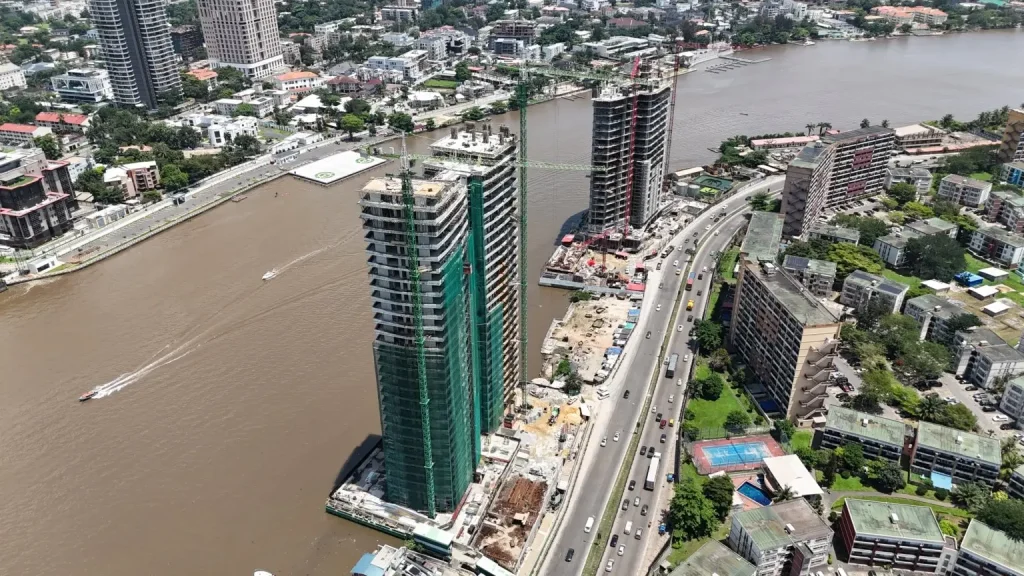
The development of Quantum Luxury Towers on the Waterfront of Victoria Island, Lagos Nigeria by Jim Ovia’s real estate company Quantum Luxury Properties Ltd. Image source SkyscraperCity
Macro Economic Impacts: Elevating Nigeria’s Investment Profile
The entry of institutional-grade private capital into mega-structural projects carries far-reaching benefits for Nigeria’s broader economy:
- Direct Capital Retention: By building world-class high-rises locally, high-net-worth investors and diaspora capital remain within the domestic economy rather than capital flight into off-shore property markets like Dubai or London.
- Ecosystem Job Creation: Large-scale developments like the Metropolitan Towers generate thousands of direct and indirect jobs spanning structural engineering, project management, skilled artisan construction, supply chain logistics, and long-term facility management.
- Metropolitan Modernization: Expanding on his earlier signature footprints, the iconic Civic Center and Civic Towers, Ovia’s continued development along the Victoria Island waterfront strengthens Lagos’s standing as Sub-Saharan Africa’s premier commercial and luxury residential hub.
Influencing Nigeria’s 20-Million Housing Deficit
Nigeria currently confronts an acute deficit estimated at over 20 million housing units. While Quantum Luxury Properties caters strictly to the upper echelon, high-end developments exert a powerful indirect influence on the country’s overall housing crisis:
The Capital Cascade Effect: Heavy institutional investments at the top tier validate real estate as a high-return asset class. This attracts new domestic and international private equity funds, deepens mortgage secondary markets, and encourages institutional developers to systematically build down-market into middle-income housing solutions.
Furthermore, as high-net-worth buyers move into newly constructed luxury towers, secondary housing inventory across commercial centers is released back into the market, easing supply pressure across mid-tier residential corridors.
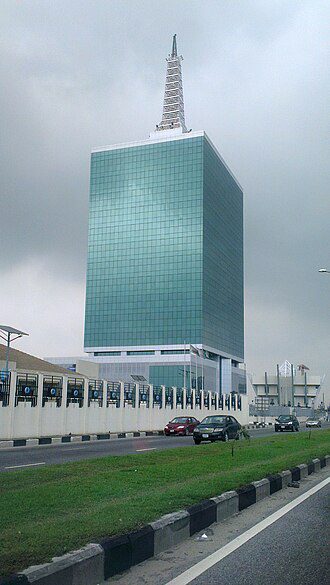
Civic Towers by Jim Ovia’s real estate company Quantum Luxury Properties Ltd. Image source: Wikipedia
Urban, Structural, and Infrastructural Impacts along the Lagos Lagoon
1. Urban Planning: Vertical Density & Waterfront Access
High-rise developments along the lagoon signal a strategic shift from horizontal sprawl toward vertical land optimization. Given that land along prime corridors like Ozumba Mbadiwe Avenue commands astronomical valuations, building upward maximizes value per square meter.
- Land-Use Intensity vs. Zoning: Vertical clusters increase population and commercial density along narrow coastal ribbons. This shifts urban planning priorities toward mixed-use zoning, where residential, corporate, and leisure activities concentrate within single high-rise corridors.
- Privatization of the Waterfront: A core urban planning concern is maintaining public access to the lagoon. As private developers acquire contiguous waterfront plots, urban planners face the task of enforcing setbacks and public promenades to prevent the complete enclosure of the shoreline by private developments.
- Microclimate & Wind Corridors: Clustering 20+ story towers alters local air movement and creates microclimatic heat island effects, requiring municipal authorities to implement stricter aerodynamic and setback guidelines in spatial planning.
2. Coastal Engineering: Geotechnical Precision & Water Dynamics
Building multi-story towers on soft, waterlogged lagoon soils requires advanced geotechnical and hydraulic engineering techniques.
- Deep Foundation Systems: Standard shallow foundations are impossible along the lagoon. Developments require continuous flight auger (CFA) or driven cast-in-situ concrete piles extending 40 to 60+ meters deep into stable subterranean strata to support immense vertical loads and resist lateral wind shear.
- Bulkheads & Sheet Piling: To prevent coastal erosion and soil liquefaction, developers install heavy-duty steel or pre-stressed concrete sheet piles along the lagoon edge. These subterranean barriers retain reclaimed soil and prevent the gradual washing away of foundation beds.
- Hydrodynamics & Tidal Surges: Altering the shoreline through land reclamation or heavy seawall construction changes the lagoon’s hydraulic flow. Pushing the shoreline outward can displace water into adjacent, less-protected communities during high tides or storm surges, requiring regional hydro-modeling rather than site-isolated engineering.
3. Municipal Infrastructure: Decentralization & Load Management
While mega-structures elevate the skyline, they place significant demands on municipal networks. Because municipal utilities are often overburdened, high-rise developers along the lagoon must build fully decentralized internal systems:
- Power Generation & Microgrids: The public grid cannot consistently supply the high-voltage demand required for central HVAC systems, high-speed elevators, and water pumps. As a result, towers build self-contained microgrids powered by heavy industrial gas or diesel generators, integrated with solar arrays and battery storage.
- Water Treatment & Waste Management: Without central municipal water mains or utility-scale sewage connections, developments install dedicated reverse osmosis purification plants to treat groundwater. They also run advanced on-site sewage treatment plants (STPs) that recycle wastewater for cooling towers and landscaping.
- Stormwater Retention & Drainage: Torrential rains and high water tables create severe flash flood risks. Developers incorporate massive underground attenuation tanks and automated sump pump systems to store surface runoff and control its discharge back into the lagoon.
- Traffic Integration & Water Transit: Adding thousands of residents to single arterial roads like Ozumba Mbadiwe creates major traffic bottlenecks. To address this, projects combine multi-level parking podiums with private jetty docks, enabling residents to bypass road congestion using water taxis across the lagoon.
The Structural Reality: High-rise luxury developments along the Lagos lagoon operate as semi-autonomous “infrastructure islands.” While they solve their internal energy, water, and security needs privately, their long-term sustainability depends on coordinated municipal investment in coastal drainage, regional transport networks, and integrated urban planning.
Ola Sheu Property & Co.
Real Estate Correspondent, Buildace Magazine