Images source: PT WORLD
Morocco is undergoing a massive transformation, positioning itself as the undisputed economic and transit bridge between Africa, Europe, and the rest of the world. At the heart of this ambition is a staggering $1.3 billion (12.8 billion dirham) overhaul of Casablanca’s Mohammed V International Airport.
Far from a routine facelift, this mega-project is a complete reimagining of Moroccan infrastructure. Spearheaded by the Office National des Aéroports (ONDA), the expansion recently crossed a major milestone with the completion of primary earthworks, paving the way for a modular, 600,000-square-meter aviation marvel set to fully open its gates by late 2029.
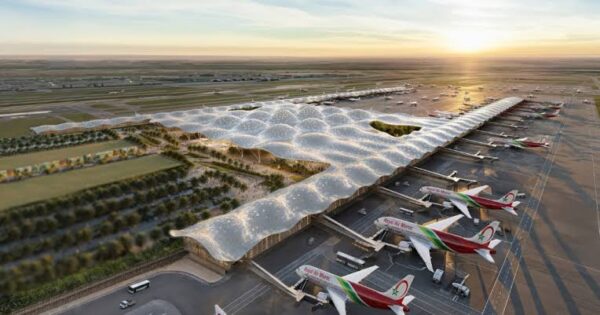
600,000-square-meter aviation marvel set to fully open its gates by late 2029
Exclusive Architecture: Where High-Tech Meets Heritage
The aesthetic blueprint of the new terminal moves away from traditional, sterile airport designs, opting instead for a striking “H-shaped” layout crafted by a powerhouse global consortium.
- The Design Brains: British architectural pioneers RSHP, French engineering giant Egis, and local cultural experts ALA Concept teamed up to fuse ultra-modern efficiency with deep-rooted Moroccan identity.
- The Aesthetic: The terminal features a spectacular, undulating roofline inspired by the crashing waves of the Atlantic Ocean.
- The Oasis Experience: Inside, passengers will navigate three stories of light-filled spaces punctuated by indoor “oasis” zones, lush green spaces designed to lower traveler stress.
- A Unified Precinct: ONDA launched a $32 million international competition to seamlessly redesign and merge the existing Terminals 1 and 2 into this new ecosystem, ensuring a cohesive, eco-friendly aesthetic across the entire complex.
Beyond aesthetics, the architectural footprint includes a towering 42-meter air traffic control hub, a fresh 3,700-meter parallel runway, and a premium 300-room airside hotel to cater to high-end business travelers and long-haul transits.
The 2030 World Cup: Driving the Countdown
Morocco’s timeline isn’t arbitrary. The nation is co-hosting the 2030 FIFA World Cup alongside Spain and Portugal, an event that will turn the global spotlight squarely onto North Africa.
“The expansion is strategically engineered to handle the massive, concurrent influx of international football fans, ensuring their first and last impressions of Morocco are world-class.”
To make the fan experience seamless, the airport is ditching isolated transit models in favor of a true multimodal hub. The new terminal will feature a dedicated, direct connection to Morocco’s expanding LGV high-speed rail network. Football fans landing in Casablanca will be able to hop onto high-speed trains slicing through the country, slashing transit times to other host cities from Kenitra to Marrakech.

“The expansion is strategically engineered to handle the massive, concurrent influx of international football fans.
Economic Ripples: Fueling the Kingdom’s Growth
An infrastructure project of this magnitude acts as a massive economic engine. By supercharging Mohammed V Airport’s capacity from its current limits to a roaring 35 million passengers annually, Morocco is directly investing in its tourism, logistics, and trade sectors.
- Domestic Job Creation: The main construction phase relies on a 50/50 joint venture between Morocco’s two largest domestic construction powerhouses, SGTM and TGCC, alongside initial earthworks by STAM. This keeps a massive portion of the $1.3 billion capital circulating directly within the local economy, creating thousands of specialized engineering and construction jobs.
- Long-Term Business Ecosystem: The inclusion of a massive new duty-free zone, premium VIP lounges, and a luxury hotel ensures sustainable, long-term non-aeronautical revenue streams that will bolster Casablanca’s status as a premier African financial hub.
The Broader Horizon: Morocco’s Skyward Expansion
The Casablanca mega-project does not exist in a vacuum. It is the crown jewel of ONDA’s larger $4.3 billion “Airports 2030” master plan, aimed at upgrading the country’s entire aviation grid to handle skyrocketing global interest.
Under this broader initiative, major upgrades are simultaneously rolling out across other key cultural and economic hubs:
- Marrakech: Target capacity scaling up to 16 million passengers.
- Tangier: Being upgraded to handle 7 million passengers.
- Agadir: Matching Tangier with a 7 million passenger baseline.
The Continental Flight Network
This expansion places Morocco at the forefront of a broader African aviation boom. Across the continent, nations are racing for the skies to capture expanding trade routes. While Kenya modernizes its vital Jomo Kenyatta International Airport, and Ethiopia pushes forward with its massive Bishoftu project aimed at becoming Africa’s largest hub, Morocco’s unique blend of high-speed rail integration and European proximity gives it a distinct, competitive edge for the future.

This expansion places Morocco at the forefront of a broader African aviation boom.