The Future of Cities is Urban Planning
When news broke that Dubai’s Roads and Transport Authority (RTA) opened prequalification for its $9.2 billion (AED 34 billion) Gold Line Metro, standard financial columns treated it as another lavish headline from the Arabian Peninsula. Contractors have until August 17, 2026, to submit their bids for a project that will carve an entirely underground, 42-kilometer transit artery by September 2032.
But beneath the staggering dollar sign lies a masterclass in urban planning that holds critical, transformative lessons for rapidly growing economies, most notably across the African continent. Dubai does not build rail networks to fix traffic after a city has choked; it builds them to dictate where the city will breathe next.
1. Concrete over Speculation: Moving Before the Crowds Arrive
The defining characteristic of the new Gold Line is its aggressive forward-planning. The 18-station network is designed to run through 15 strategic urban zones, explicitly connecting to over 55 major real estate development projects currently under construction. For many booming African megacities, like Lagos, Nairobi, Cairo, or Johannesburg, infrastructure is historically reactive. Governments wait until a district is heavily populated and completely paralyzed by traffic before attempting to acquire expensive land to retroactively squeeze in roads or rail.
The Dubai Blueprint: By embedding transit corridors directly into the master plans of unborn neighborhoods, the RTA ensures that 1.5 million future residents will possess mass-transit access from the moment they move in. It shifts transit from an emergency remedy to a fundamental engine of real estate and economic growth.
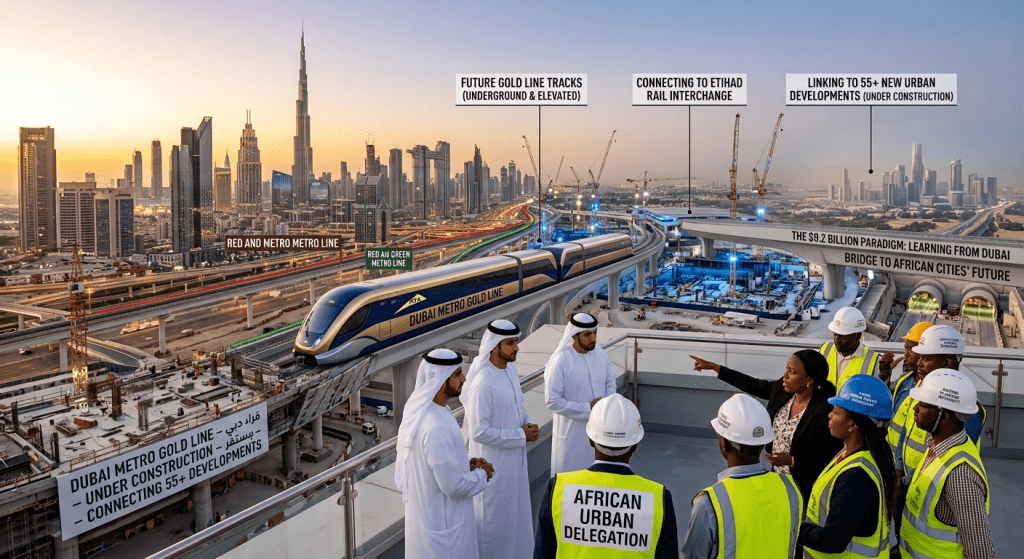
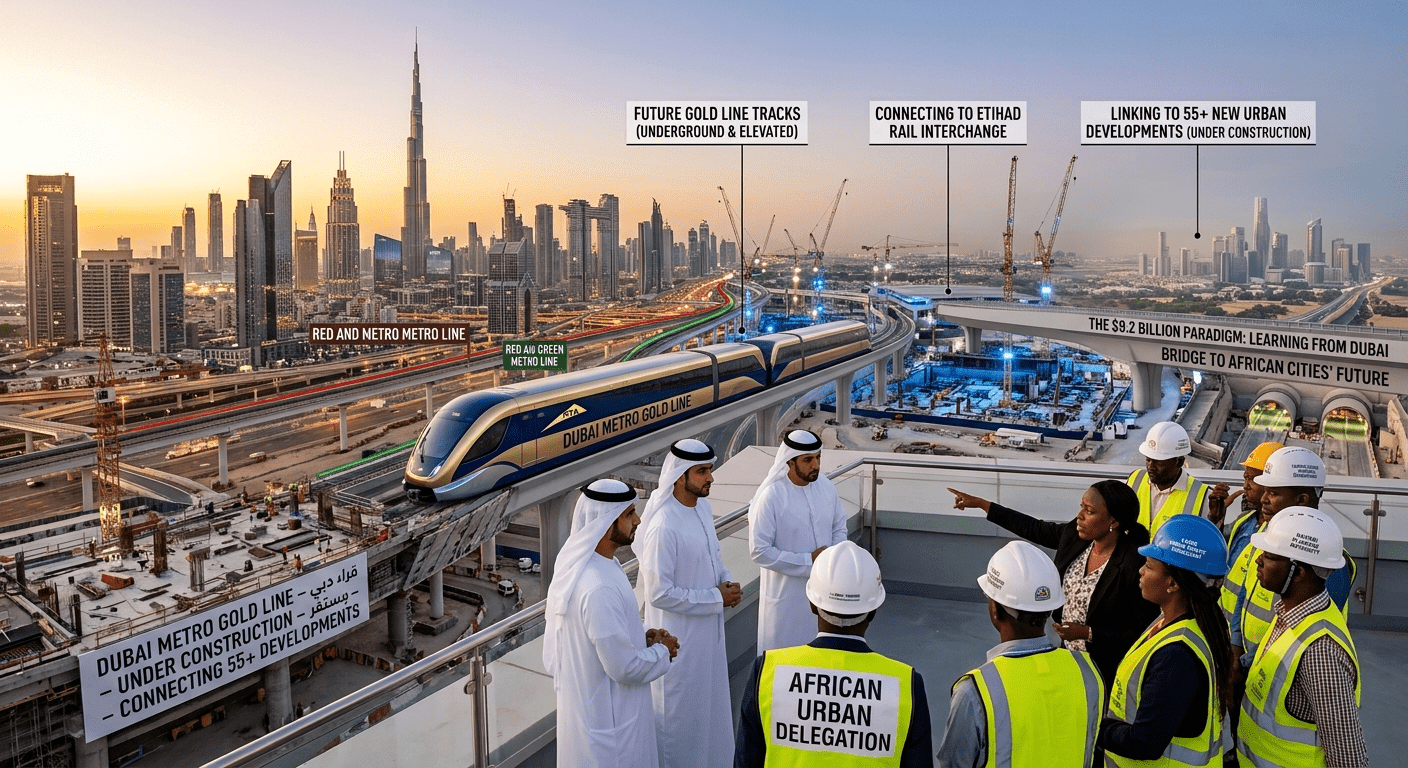
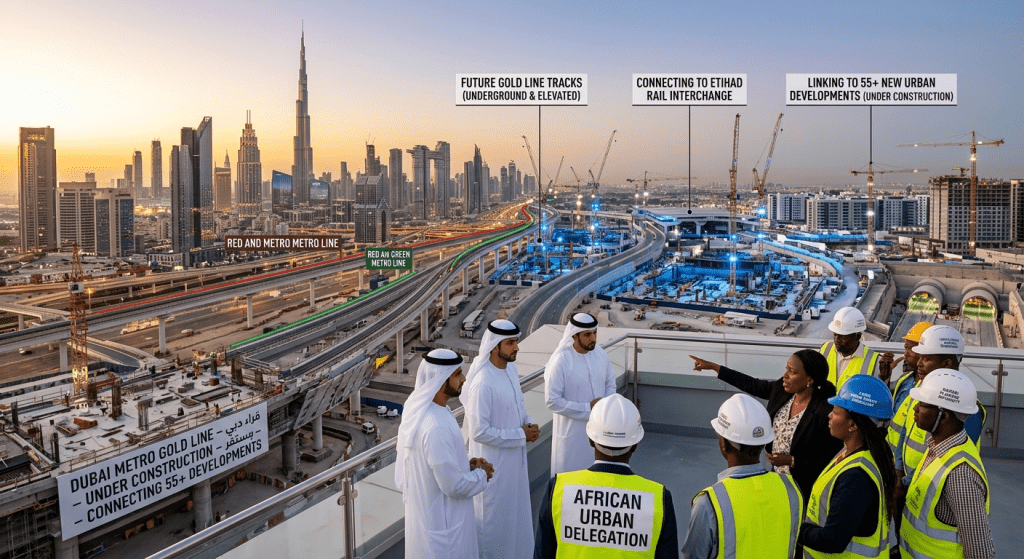
This image and the cover image are Gemini AI generated as illustrations the project in this article.
2. True Multimodal Integration: The Death of the Transit “Silo”
The Gold Line is not designed to operate in a vacuum. Spanning from Al-Ghubaiba in historic Bur Dubai to the suburban Jumeirah Golf Estates, the line acts as a massive suture across the city’s existing infrastructure. It intersects seamlessly with:
- The existing Red and Green Metro Lines.
- The upcoming Etihad Rail passenger line, linking urban transit directly into regional and national logistics networks.
In contrast, many African urban transit attempts suffer from a lack of connectivity. A commuter might take a modern light rail line, only to exit into a chaotic environment with no organized connection to buses, ferries, or regional trains. Dubai proves that a transit network’s true value is determined by its intersections; a single card and a single seamless transition must get a passenger from a suburban neighborhood to an international rail hub.
3. The Math of Mass Transit: A 430% Return on Investment
To critics who view a $9.2 billion underground metro as a luxury only oil-wealthy nations can afford, Dubai’s economic projections offer a sharp reality check. The RTA projects a 430% cumulative economic return over 20 years of operation, driven by:
- Massive reductions in fuel consumption and carbon emissions.
- Slashing road accident fatality rates.
- Easing load on the heavily congested Red Line corridor by 23%, removing an estimated 40 million car journeys off the tarmac annually.
For African nations facing severe capital constraints, infrastructure is often viewed purely as a cost center. The Gold Line flips this perspective. High-capacity rail is an aggressive revenue generator that claws back billions in lost productivity currently wasted by citizens sitting in gridlocked traffic.
The Takeaway for African Urban Centers
| The Old Approach (Reactive) | The Gold Line Strategy (Proactive) |
| Build roads to catch up with spontaneous, unmanaged urban sprawl. | Lay underground rail to systematically direct and support urban density. |
| Treat public transit as a secondary option for low-income earners. | Design elite mass transit that encourages all demographics to leave cars behind. |
| Isolate rail, road, and maritime transit into separate, unlinked networks. | Enforce structural integration where regional trains meet local metro lines. |
With international engineering firms like Aecom already anchoring the design phases, Dubai is demonstrating that world-class infrastructure relies heavily on momentum, rigorous timelines, and early execution.
As Africa’s urban population is projected to cross 1 billion people in the coming decades, continuing to rely solely on expanding tarmac roads for cars and minibuses is a mathematical impossibility. True economic freedom for the continent’s megacities will require adopting this exact proactive mindset: building the high-capacity, integrated rail arteries of tomorrow before the gridlock of today becomes permanent.
Onoruoyiza Abdulrahaman, Buildace Magazine