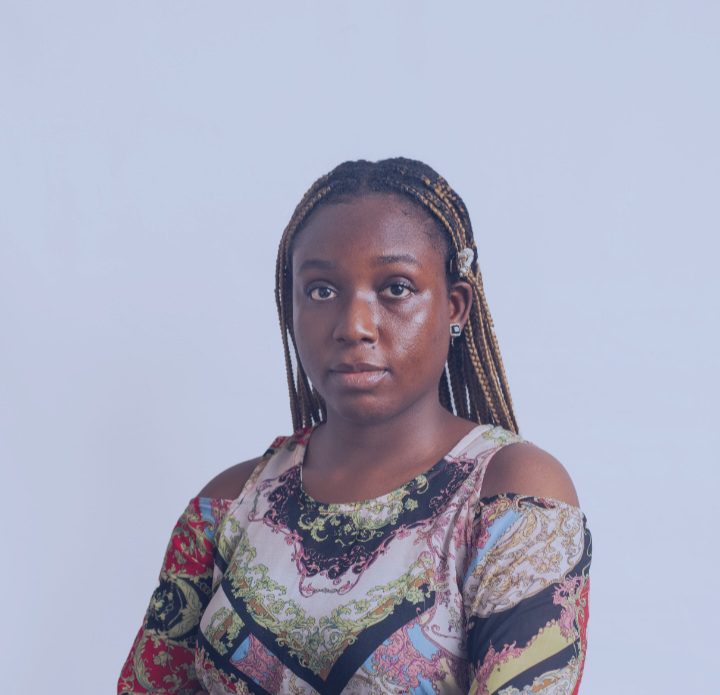
My name is Ikpekri Favour Eloho, a B.Tech. Architecture graduate, intern architect at Illume Development, and emerging architectural journalist. I graduated in 2025 and began gaining professional experience during my Industrial Training at Harcourt Adukeh & Associates in Rumuibekwe, Port-Harcourt, Rivers State, Nigeria. My undergraduate hostel project remains one of the academic projects that I am most proud of, while my current role at Illume Development continues to expose me to the realities of architectural practice beyond the classroom.
My interest in architectural journalism grew from curiosity and a desire to find answers to the questions that often go unanswered in architecture. I see myself as a bridge between questions and answers researching, asking professional’s questions and bringing those answers to a wider audience. I began exploring this through architectural articles and reflections published on LinkedIn (@Ikpekri Favour), one of the biggest and most popular professional social media platforms.
My interest extends beyond designing buildings. I am particularly drawn to cultural architecture, including museums, cultural centers, residential buildings that reflect local identity, and even restaurants where architecture and culture intersect. Residential architecture remains one of my strongest interests. I also enjoy visiting new places and writing about what I discovered, as well as cooking and watching movies.
I believe that architectural communication is an underexplored space in Nigeria. While the industry often focuses on showcasing designs, selling properties and promoting projects, I believe there is room for more conversations about the people, ideas, processes and realities behind architecture.
My ambition is to become a voice for architecture someone the public and building professionals can turn to when they need their ideas, experiences and perspectives communicated. For me, architectural journalism is ultimately about asking better questions, finding the answers and making architecture easier to understand.
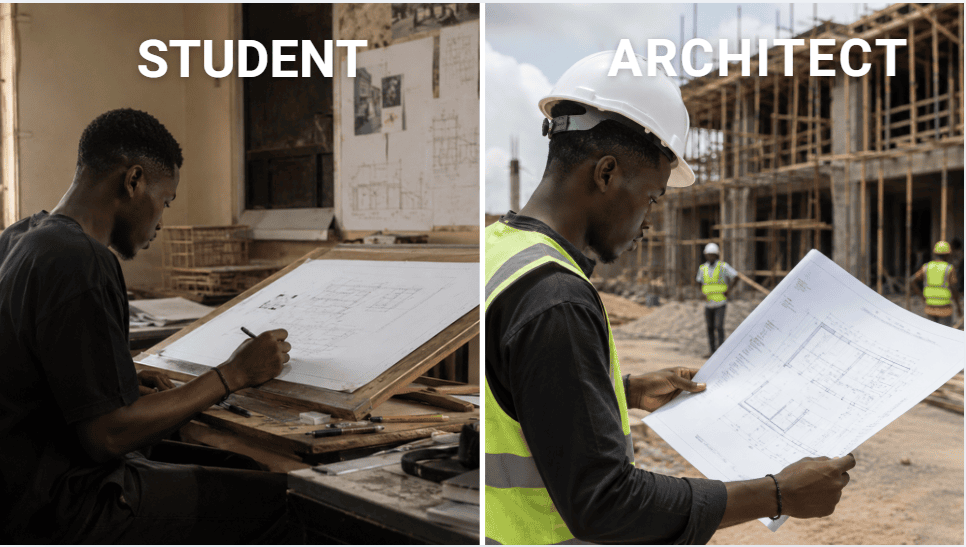
An AI generated image to illustrate the transition from student to architect.
The Transition to Professional Life as an Architecture Graduate
In this article, I talked about the transition from student to professional life in the field of architecture, citing myself as a living example.
“How hard can it be? Architecture is all about drawing. Not much reading or calculation, like the bridge between art and science.” So I thought. Until I gained admission into the Federal University of Technology, Owerri, Imo State, Nigeria. No one told me I had to be good at drawing, graphic design, or even have good handwriting. Maybe I should have done a lot more research before deciding that this was what I wanted to study.
In my first year, we had three design-related courses, while the rest were more conventional university courses. These courses were Design, Graphics and Lettering, and Freehand Sketching. One day, my Freehand Sketch lecturer came out, looked around, and pointed at every building he could see, pointed at two trees, and told us to draw them. I was confused. I clearly didn’t sign up for an art class. Every period with him, we would come outside with a drawing board, paper, and pencil and simply sketch. You had to look at what was in front of you and somehow translate it onto paper. The problem was, I didn’t know how to draw. So most of the time, I did nothing.
And that wasn’t all. Graphics Design would give you a drawing and tell you to reproduce it. You would think, well, that’s easier. I just have to trace it. Except you can’t trace shading techniques. You could trace the outline, but you couldn’t simply trace the skill behind the drawing. You had to understand how to bring the drawing to life. Then there was handwriting. I never knew my bad handwriting was going to matter. But suddenly, something I had never considered important was part of my architecture education.
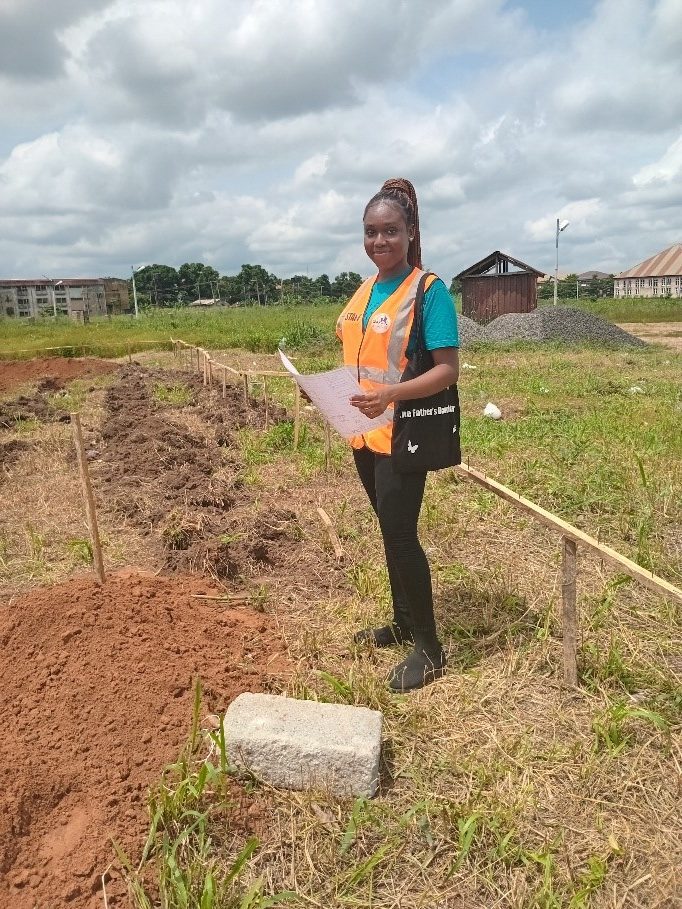
Ikpekri Favour Eloho on site.
Handwriting
Then came the turning point: the COVID-19 lockdown. We all went home, and the long break unexpectedly gave me something I needed, time. I started learning how to draw. I practiced my handwriting like I was some little kid all over again. I kept practicing because I knew I didn’t want to return to school with the same weaknesses. When we eventually returned, I got an A in Freehand, a B in Graphics, and an A in Handwriting. I was so happy and proud of myself. I thought I had it all figured out now. I didn’t know it yet, but I had only just marked out the site. I hadn’t even started excavating.
Semester after semester, I would question myself: Should I drop out? Somehow, I didn’t. Every design topic seemed to become tougher as I progressed. The projects became more complex, and the expectations became higher. But there were things about architecture school that I genuinely enjoyed. I enjoyed traveling to visit buildings, meeting people, and learning about different ways of life. Architecture gave me opportunities to experience things I probably wouldn’t have experienced otherwise.
For one project, I was asked to design a cultural center for the Itu community in Imo State, Nigeria. To properly understand the community, I had to visit the palace and learn about the culture of the community from the Igwe (king). Those experiences were different from sitting in a studio trying to complete a drawing. They reminded me that architecture was not just about buildings. It was about people, culture, and the way people live. I guess those little experiences were what kept me from giving up.
Students drawing during night class, breaking the next morning.
Working Drawing in my Final Year
Then came Working Drawing in my final year. Until then, much of architecture school had been about designing beautiful buildings. Sometimes, when we met our lecturers for corrections, they would look at our drawings and simply say, “It cannot work.” And in my mind, I would ask, why? Working Drawing began to answer those questions. Could this building actually stand? Was it safe? How would it be constructed? What exactly would another person need to know to build what I had designed?
We spent endless nights producing dimensions, descriptions, and detailed information on exactly how the building would be constructed, drawings so precise that, theoretically, if you sent the document to another architect in another country, they would be able to understand how to build it even without your presence. You see, this is the drawing we don’t show the world.
The workload was so much that the day was never enough. We had to add the night. Even that sometimes wasn’t enough. We spent money buying paper and ink. We brought our drawings to life with hardboards and other materials. We stayed up late, turning ideas that existed in our heads into drawings and physical models that could actually be understood and, eventually, built.
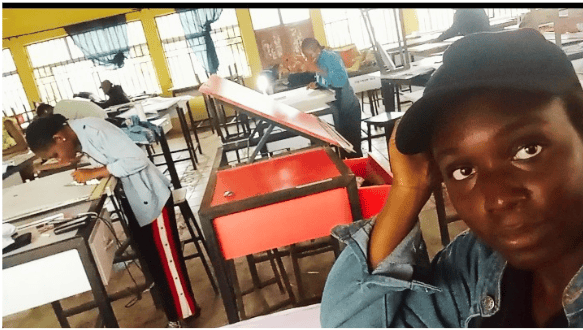
Students working drawing during the day.
The Transition
Then I graduated. I was so happy. “Thank God, I am free.” Then what? What happens after graduation?
I reached out to several architects at different stages of their careers and asked about their transition from architecture school into professional practice. I wanted to know what changed after graduation and what young graduates should know before entering the profession. Only a few responses came back, but one of them stood out to me.
The first thing that became clear was that graduation is not the end of the learning process. It is the beginning of learning architecture in a completely different way. After graduation, you begin to adjust from being a student to becoming a professional. You learn how to work with registered architects, understand the rules and ethics of the profession, manage your time, and take your professional development more seriously.
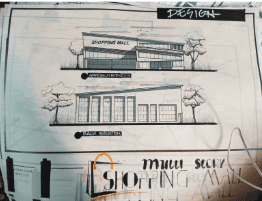
Example of drawing on paper.
Where you Start Matters
You also begin to realize that where you start matters. The architectural firm you begin your career with can have a significant influence on the skills and experience you develop over the years. Your first few years are not just about getting a job; they are also about deciding what kind of architect you want to become.
If you want to develop strongly in construction and site work, then you need to seek out a firm where you will actually be exposed to construction and site management. If your interest is design, then you need an environment where design is taken seriously and where you can learn and grow in that area. You cannot expect to become good at something you are rarely exposed to.
That made me realize that getting your first architectural job should involve more than simply asking, “Who will employ me?” You should also be asking: “What will I learn here?” Because the experiences, skills, and habits you develop in those early years can shape the kind of architect you eventually become.
As a student, there is usually someone telling you what to do next. There is a lecturer giving you a brief. There is a deadline. There is a correction. There is always someone asking, “Have you done this?” Professional life is different. You have to begin taking responsibility for your own development. You have to seek experience, find people you can learn from, and deliberately put yourself in environments that move you towards the kind of professional you want to become.
There is also the journey towards professional registration. The degree is not necessarily the final destination. There are still professional steps to take, and the experience you gain after school can help prepare you for them.
It made me realize something. In school, I was constantly worried about whether my designs were good enough. After graduation, the question changes. It becomes: “Am I becoming good enough to practice?”
Am I Becoming good enough to Practice?
The transition is not simply about leaving university and getting a job. It is about changing the way you think. You move from designing for a lecturer to designing for clients, communities, and actual sites. You move from drawings that are being assessed to drawings that may eventually be built. And suddenly, the things I once thought were just requirements for passing architecture school begin to make more sense.
The late nights. The working drawings. The endless corrections. The pressure to understand how a building actually works. Maybe they were all preparing us for this part.
I thought graduation meant I had finally finished. But perhaps I had misunderstood the whole journey. I had finished being an architecture student. I had not finished becoming an architect.
That was only the beginning.
Ikpekri Favour Eloho
B.Tech. Architecture graduate
Federal University of Technology, Owerri,
Imo State, Nigeria.